
I first saw the Reichstag Building shortly after the Wall came down. At the time it stood scarred and grimy, its stone walls pocked with bullet holes from the Battle of Berlin in 1945. It felt less like a government building than a wounded monument. At the time, the government was operating in Bonn. Later I returned after its dramatic reconstruction but had never managed to take the official tour. This time, knowing tickets disappear months ahead, I asked my nephew Matt to reserve spots as soon as my flights were booked.
The Reichstag’s history mirrors Germany’s own turbulent story. Completed in 1894 during the German Empire, it served as parliament until the infamous 1933 Reichstag fire, an event the Nazis exploited to consolidate power. During World War II the building became a symbolic target, culminating in the Soviet assault on Berlin. The iconic photograph of Soviet soldiers raising the red flag over the Reichstag marked the approaching end of the war in Europe. Afterwards the battered building stood isolated near the Berlin Wall, physically and symbolically stranded on the edge of West Berlin, with the Russian sector and East Berlin directly across the street.
Today it is again at the heart of a unified Germany, beside the Spree River and near the Brandenburg Gate, an extraordinary location where so much of modern European history converges.
What struck me most on the tour was how carefully the reconstruction balances history with modernity, transparency, and optimism. British architect Norman Foster won an international competition to redesign the building after reunification. Rather than erase the scars of history, he incorporated them. Soviet graffiti left by Red Army soldiers in 1945, names, curses, declarations of victory, remain preserved on interior walls. Standing in front of those scribbled messages, it is impossible not to feel the immediacy of war and conquest.
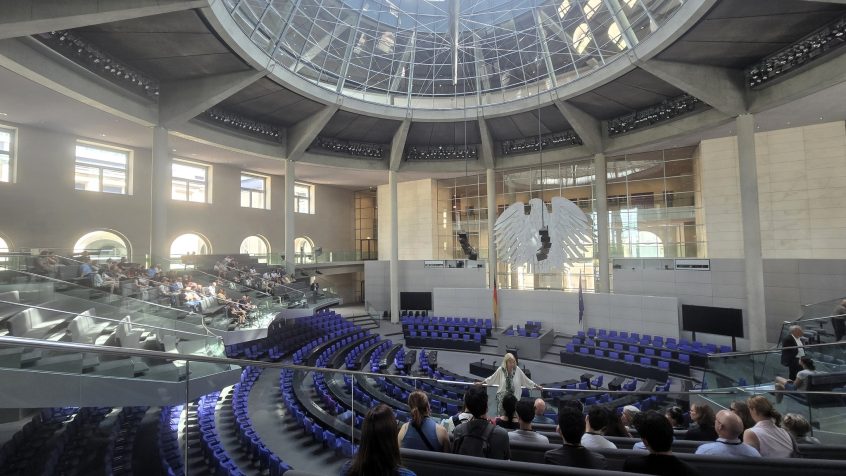
At the same time, the building is unmistakably modern. The parliamentary chamber is bluish-purple, chosen to be different from colors associated with any party. Historic stone walls and columns blend seamlessly with glass, steel, and light.
And then there is the dome.
The vast glass dome rising above the Reichstag has become one of Berlin’s defining symbols. Visitors spiral upward along gently sloping ramps while, below them, parliament conducts its business. The symbolism could not be clearer: the people literally stand above the government in a transparent democracy. Mirrors at the center funnel natural light down into the chamber while also helping regulate temperature and ventilation, making the dome both symbolic and environmentally innovative.
But beyond the symbolism, it is simply stunning. Berlin spreads around the dome; cranes, church spires, modern office towers, parks, waterways, and monuments to every era of German history. The city looks both ancient and unfinished. It is still reinventing itself.
From there we walked to lunch for sushi, one of those reminders that Berlin today is an international city. Afterwards we boarded a boat for a cruise along the Spree River. Seeing Berlin from the water offered yet another perspective, monumental museums, sleek modern architecture, government buildings, graffiti covered walls, and pockets of green unfolding continuously along the banks.
Because it was a warm day and a holiday weekend (no, not Memorial Day, Pentecost), hundreds of people sat along the riverbank eating, drinking, or simply enjoying the sun.
Later we wandered down Unter den Linden, the grand boulevard once associated with Prussian royalty and military parades. Today it is filled with tourists, students, cyclists, street musicians, and protests. The one we saw, which happens every weekend, was by Iranian Royalists. We even saw a Turkish wedding party drive by, horns honking.
One unexpected fun stop was the Volkswagen Group exhibition on “Icons,” a celebration of design, technology, and cultural memory. The exhibit mixed nostalgia with innovation, but my favorite moment was watching Matt and Asher become completely absorbed in a retro game of Pong. There was something delightfully perfect about seeing multiple generations laughing over one of the earliest video games inside a sleek contemporary exhibition space.
We ended the day at the top of the Berlin TV Tower that still dominates the former East Berlin skyline. Built by the GDR as a demonstration of socialist modernity and technological prowess, it now serves mostly as a reminder that cities outlive the ideologies imposed upon them. Over dinner, as the restaurant rotated, we watched Berlin stretched endlessly below us.