
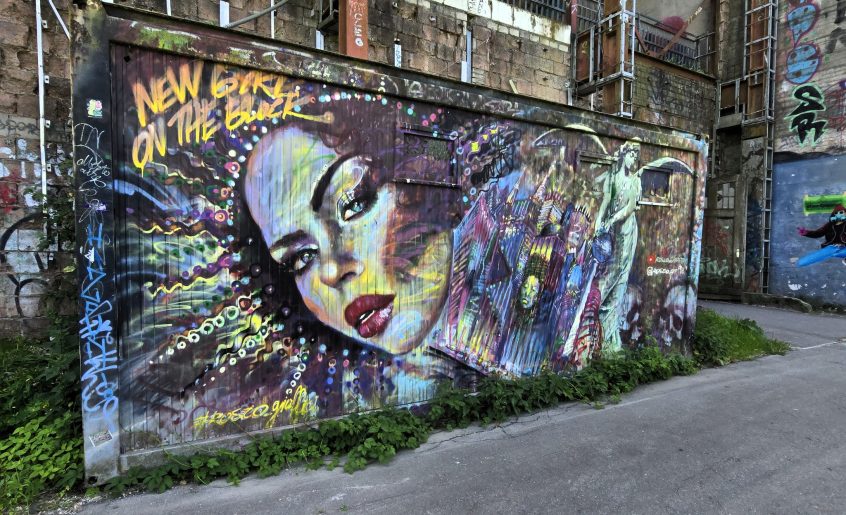
Teufelsberg, Devil’s Mountain, was on my list of must see sites in Berlin. It is located in the middle of the vast Grunewald forest. I went there thinking the main attraction would be the street art. While the street art is extraordinary, the history proved just as compelling.
Teufelsberg was built from the rubble left behind after WWII. It was originally planned as a recreational facility for Berliners. During the Cold War it became a listening post used by the United States, Great Britain, and France to spy on East Germany. After the Cold War it fell into disrepair. Now it has evolved into one of the largest street art galleries in Europe.
One of the exhibitions focuses on the history of the area. What most captured my attention was film shot by Americans flying over Berlin at the end of the war. Seeing the devastation from the air was genuinely shocking. Even more astonishing was contrasting today’s vibrant metropolis with the endless sea of ruins visible in the footage.
The street art covers nearly every wall, the bright paintings against crumbling concrete somehow echoing the city’s larger history.
After several hours wandering through Teufelsberg, I headed back toward central Berlin. I wanted to visit Art Cru Berlin, the city’s only Outsider Art gallery. I was disappointed in the exhibit itself, but ended up having a wonderful conversation with the woman working there. She offered suggestions for other places I might enjoy exploring.
The gallery is just down the block from the New Synagogue Berlin. It is another place that serves as a reminder of the city’s turbulent and terrible history. From the outside, the synagogue has been beautifully rebuilt. Inside, the atmosphere is somber, shaped as much by memory as architecture.
When I returned to my room, I fell asleep almost instantly. Maybe it was the heat, the miles of walking, or simply the emotional weight of the day. Yet one sweet note lingered. The lilacs are blooming in Berlin, and their scent drifts through the neighborhood and into my room.