
I spent the better part of today at Berlin’s New National Gallery. The building is as much a work of art as the collections inside. Designed by famed architect Ludwig Mies van der Rohe and completed in 1968, it was his final major project. The soaring steel and glass structure feels open and elegant.
Matt and I started with the Constantin Brancusi exhibition, much of it on loan from the Centre Pompidou in Paris (currently being renovated). I had never seen so many of his works gathered in one place. His sculptures have a deceptive simplicity, smooth abstract forms that somehow feel both ancient and modern at the same time. In addition to the sculpture, there were a few of Brancusi’s paintings, including a mesmerizing self-portrait.
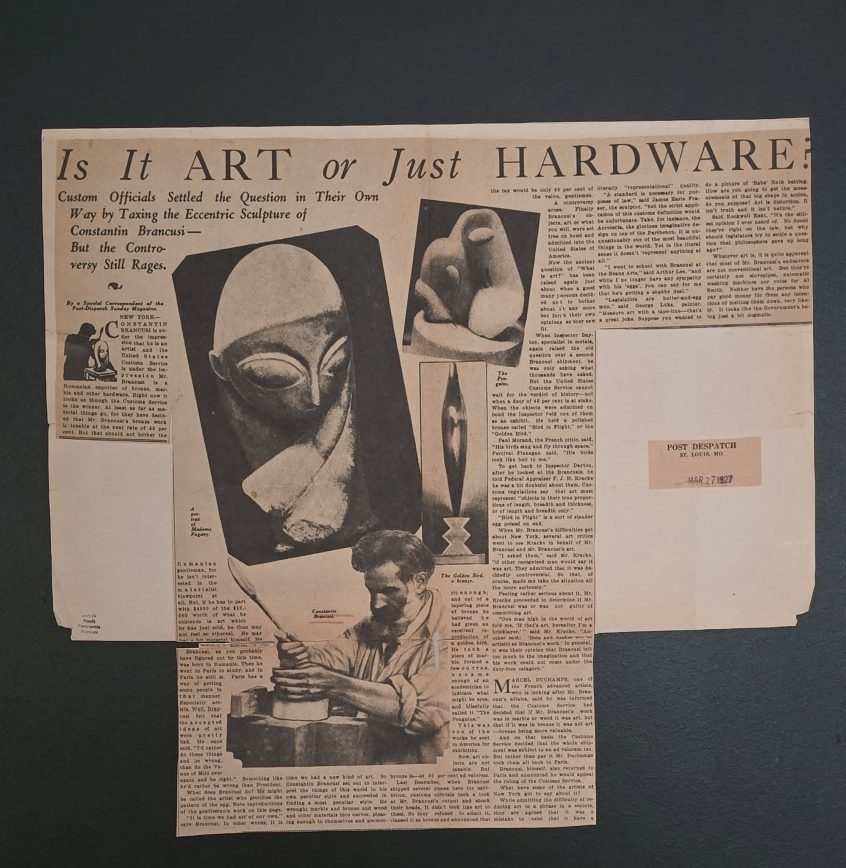
In addition to the art, there was a fascinating display about how Brancusi’s work was initially received in the United States. Judging from the newspaper clippings and commentary on display, many Americans did not think it was art at all. One section explained the famous 1926 customs battle over his sculpture Bird in Space. Because the piece did not resemble a literal bird, U.S. customs officials classified it as an industrial object rather than a work of art and attempted to charge import duties. The resulting court case became a landmark decision in defining modern art.
There was also an exhibition about Berlin during the years between the two World Wars. During the Weimar era, it was a city simultaneously bursting with creativity and sliding toward catastrophe. The galleries explored this explosive cultural life, with paintings, photographs, film clips, posters, and political commentary capturing both the glamour and instability of the time. At several moments I could not stop the songs from Cabaret from drifting through my head. The exhibit conveyed the same uneasy mixture of artistic freedom, decadence, anxiety, and looming danger. At that point, Matt departed because he had work to do and I continued on my own.
The main collection spans much of twentieth century modernism, arranged by decade. There were works by artists whose names are instantly recognizable alongside others I had never encountered before. Some pieces captivated me immediately, others left me puzzled. All reflected a period when artists seemed determined to reinvent how people saw the world.
One final special exhibition focused on Gerhard Richter. His work ranges from blurred photo realistic paintings to vast abstract canvases layered with color and texture. What struck me most was his refusal to settle into a single style. Just when I thought I understood what he was trying to say, he changed direction completely.
What I came away with, apart from simply enjoying the art, was something I have noticed in museums and galleries around the world. There are so many extraordinarily talented artists who never become internationally famous. We tend to hear the same handful of names repeated endlessly, while countless others create remarkable work that remains largely unknown outside their own countries.
By the time I had seen it all, I was exhausted and famished. I took a bus to KaDeWe, Berlin’s huge, famous department store. I remembered that the top floor has an excellent restaurant and food hall with expansive views across the city. After a day immersed in modern art, history, and ideas, sitting there with my late lunch and looking out over Berlin felt like exactly the right ending.