
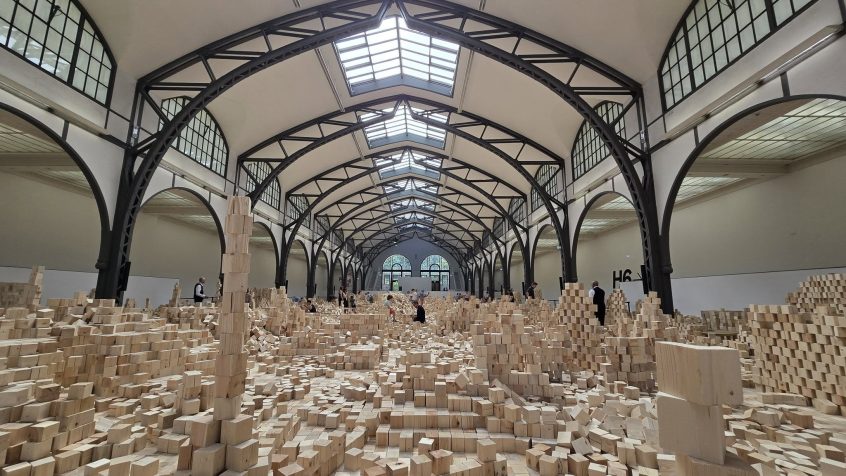
After many visits to Berlin over the decades, beginning about a year after the wall came down, I have returned to this fascinating city. I thought I’d seen a lot of Berlin, but I’m staying in a neighborhood entirely new to me, the Grunewald district. It’s a very green area, dotted with artificial lakes and very expensive mansions.
My nephew Matt, his partner Leonie, (with their son Asher) are spending the year here as fellows at the Wissenschaftskolleg zu Berlin, better known as the Wiko Institute. The institute brings together scholars, scientists, writers, and artists from around the world, giving them the rare luxury of uninterrupted time to think, research, and exchange ideas across disciplines. It occupies elegant villas in this quiet enclave apart from Berlin’s edgier neighborhoods and tourist centers. Had someone dropped me here blindfolded, I would never have guessed I was in one of Europe’s great capitals.
Being back in Berlin after a decade away has been fascinating. The city still carries its layers of history and creative energy, but it feels sleeker, wealthier, and more polished than the Berlin I first encountered in the early 1990s, when construction cranes dominated the skyline, many buildings still carried bullet holes from WWII, and traces of division remained everywhere. Though that has mostly disappeared, the city retains much of its edginess and creative energy.
Today, minus Asher, we visited Hamburger Bahnhof, one of the city’s leading contemporary art museums. When Matt told me I knew I had to visit it because I am writing a series of articles for Journey Woman about repurposed places. Hamburger Bahnhof has a remarkable history. Opened in 1846 as a railway station connecting Berlin and Hamburg, it is the city’s only train station remaining (in any form) from that time. After years of varied use and wartime damage, it was transformed into a museum for contemporary art, its vast industrial spaces well-suited to monumental installations and experimental work.
We spent much of our time in “We Make Years Out of Hours,” an immersive exhibition that blurs the lines between performance, sound, installation, visual art and playground for all ages. Rather than moving from painting to painting, visitors enter a world of sound and the largest building block set ever. The exhibition contains an astonishing 400,000 wooden cubes spread across the vast historic hall. Each individual block measures 10 x 10 x 10 centimeters, roughly 4 inches on each side, and is made from spruce and pine.
Kids and adults threw themselves into the fun, building towers and, for the littlest children, joyfully knocking them down. We lingered far longer than planned, drawn into both the scale of the installations and because the exhibit asks viewers not merely to observe art, but to inhabit it. At one point we watched a performance piece in which singers built structures and would periodically burst into song.
The other exhibits were equally creative and engrossing. One that intrigued me was an installation devoted to books published anonymously or under pseudonyms. The display explored the many reasons writers have concealed their identities over the centuries, political danger, censorship, gender discrimination, social expectations, or simply the desire for privacy.
George Eliot, the pen name used by Mary Ann Evans, was used so that her work, including Middlemarch, would be taken seriously in the male-dominated literary world of Victorian England. The Brontë sisters first published under the ambiguous names Currer, Ellis, and Acton Bell, hoping readers and critics would judge the novels without prejudice against female authors.
The exhibition also included more contemporary examples. Mystery writer and literary scholar Amanda Cross used a pseudonym to separate her academic career at Columbia University from her detective fiction. J. K. Rowling was encouraged by publishers to use initials rather than her full first name because they feared boys might hesitate to read a fantasy novel written by a woman.
Afterward, we had lunch outside at the museum’s restaurant beside the canal, one of those relaxed urban moments Europeans seem to do particularly well. Cyclists glided past, and people lingered over meals, creating a tranquil setting.
Later we headed to Markthalle Neun, a restored nineteenth century market hall in the Kreuzberg neighborhood. It has become a center for artisanal food and small producers. Traditional vendors of wurst, cheese, and beer coexist with craft coffee, international street food, organic produce, and trendy culinary experiments. I was surprised to notice multiple Bao (Chinese bun) vendors, but apparently they are quite the rage in Berlin. While I rested and people watched, Matt and Leonie bought food for dinner.