
This morning, I met Thomas, my guide and driver for the next week as I head north.
For the first hour the highway was wide, smooth, and efficient. Sitting in an air-conditioned car, it was easy to forget I am in the tropics. Gradually the skyscrapers thinned, replaced by stretches of palm oil plantations and low rolling hills.
Once off the main highway and heading toward the Cameron Highlands, the character of the drive changed completely. The road narrowed and began a steady climb. Dense rainforest pressed close on both sides of the pavement, thick, tangled, intensely green. The ascent into the mountains was a series of curves and hairpins, not frightening, but demanding attention. And, as Thomas explained, the roads are cracked and bumpy because of the persistent rain, heavy trucks carrying produce into the city, and frequent mudslides. In places the road was just wide enough for two vehicles, and occasionally a truck laden with vegetables lumbered downhill. I was glad I wasn’t driving.
Along the route were small stands selling fruits, vegetables, and locally made handicrafts. They appeared on curves in the road, simple wooden tables with piles of produce and a clothesline with fruit dangling down. There were the durians, a favorite of the Malay people. They were only the beginning. There were rambutans, one of my favorite fruits. They’re bright red and covered in soft, hairlike spines, which peel back to reveal translucent, sweet flesh. I spotted mangosteens, with their deep purple shells, jackfruit, enormous and knobby, starfruit, longans, tiny bananas, and something that looked like small green golf balls, guavas.
The vegetables were equally intriguing. Though apart from lemongrass stalks, chayote, unfamiliar gourds, I couldn’t name most of them. The Cameron Highlands is one of the most fertile areas in the country. Much of the lettuce, cabbage, and temperate vegetables sold in Kuala Lumpur markets originate here. The cooler climate makes possible what would wilt in the lowlands.
As the road climbed higher and the jungle thickened, I started asking Thomas questions about the people who live in these forests. The indigenous communities of Peninsular Malaysia, collectively known as the Orang Asli, still inhabit parts of this region. Traditionally semi-nomadic, many live by hunting, gathering, and small-scale farming in and around the rainforest. Today, some communities have settled in permanent villages along the roadside, while others maintain more traditional forest-based lifestyles. The balance between preserving culture and adapting to modern Malaysia is ongoing.
We stopped at one small community for a look. The people who live near the jungle rely on it for food, pharmacy, and livelihood. I was surprised when Thomas told me that most of the people are Christians, converted by European missionaries. He showed me their church, a small unassuming building, with a distinctive cross above the entry.
As we passed roadside stands selling baskets and woven goods I asked Thomas to stop. Apart from the beauty of the objects crafted by hand from local materials, I learned about living in the area. The proprietor, a young man, explained about the wood used to make baskets, chairs, purses and other utilitarian objects. When I picked up a small dagger-like object he gave me a lengthy explanation. It contains power and magic and is used to ward off dangerous animals.
I was surprised to learn what lives there. Deep within the forest roam creatures that sound as though they belong in adventure novels. Elusive and rarely seen is the critically endangered Malayan tiger, with fewer than 150 believed to remain in the wild. There are herds of Asian elephant in parts of the peninsula, and the small but strong Malayan sun bear. Most common, and often the most dangerous if startled, are wild boar. The snakes are equally formidable. Malaysia is home to the King cobra, the Malayan pit viper, and the nocturnal Malayan krait. No wonder they need powerful magic!
The higher we climbed, the cooler it became. I could almost feel the temperature dropping with each switchback. Kuala Lumpur had been rainy, hot, and humid, hovering near 90 degrees. By the time we reached the highlands, the air felt fresh, almost crisp. The humidity softened, the light shifted, and a mist clung to the trees, giving the landscape a slightly mysterious cast.
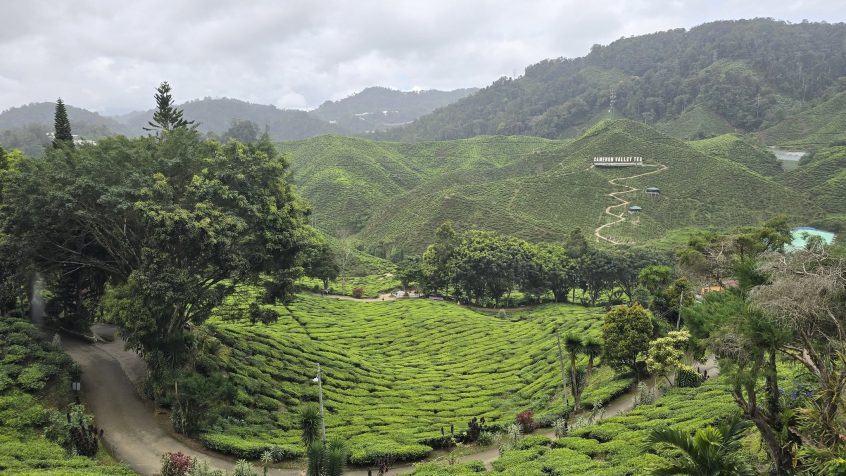
And then, quite suddenly, the jungle gave way to geometry. The hills were sculpted into orderly rows of tea bushes, their bright green curves flowing over the slopes. I began to understand why the British chose this place as a hill station retreat from the lowland heat. Established in the 1920s during colonial rule, it was designed as an escape from tropical heat, complete with Tudor-style buildings, afternoon tea traditions, and manicured gardens.
The area is famous for its beautiful tea plantations. There are also strawberry farms, flower nurseries, and fields of lettuce and cabbage, crops that thrive in this cooler climate.
Tomorrow we’ll explore the tea plantations up close. Tonight, I’m staying in a very British-looking hotel. The temperature is cool outside, not humid; the grounds are peaceful and flower filled.