
The manager of the Villa Diner came over to my table and, in a conspiratorial whisper, said, “Today’s your lucky day. Someone has paid for your breakfast.”
I looked at him incredulously. “What?”
“It’s been happening a lot today. People have been paying other people’s bills.”
When I asked if I could thank my benefactor, he told me the person wanted to remain anonymous. I was stunned. This was a first, and a delightful introduction to Charlottesville.
The city has a long and distinguished history. It was home to three presidents: Thomas Jefferson, James Monroe, and James Madison, and to the University of Virginia, founded by Jefferson.
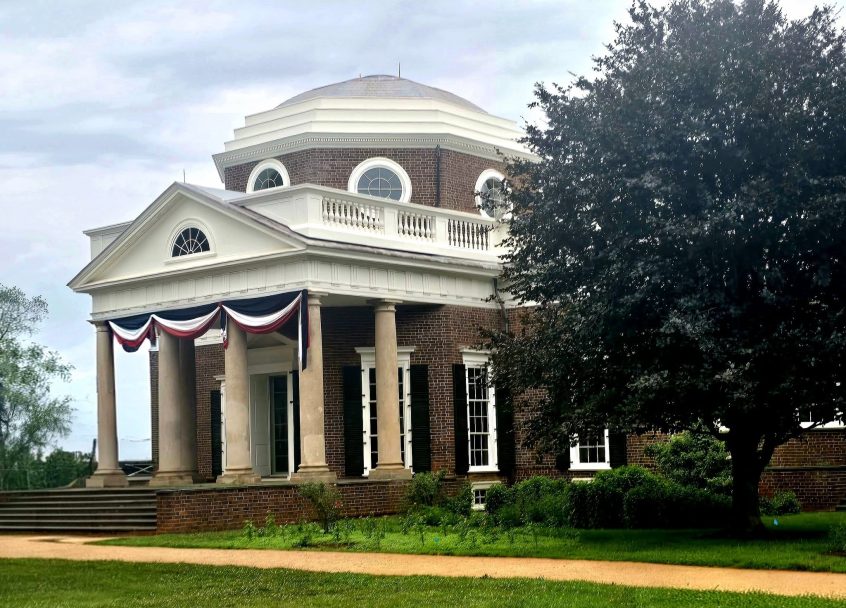
My destination was Monticello, Jefferson’s home. But before heading there I took a quick look around downtown. The historic district, including Court Square and the pedestrian Downtown Mall, predates the Revolutionary War, witnessed the Civil War, and has continued evolving ever since. Since it was drizzling, I only took a brief stroll, enough to get a feel for the city’s character.
By the time I arrived at Monticello, my luck at the diner seemed to be continuing. The drizzle stopped, the sun occasionally peeked through the clouds, and as I headed from the parking lot toward the visitor center, I ran into Jefferson—or at least an actor portraying him.
I chuckled and said, “It’s a pleasure, and also a bit odd, to meet you on the elevator.”
“Well,” he replied without missing a beat, “I’m all for labor-saving devices. I only wish I’d invented it.”
Like most Americans, I knew the broad outlines of Jefferson’s life: principal author of the Declaration of Independence, president, founder of the University of Virginia, diplomat, and a deeply complicated man whose ideals and actions often conflicted. Though he believed slavery was immoral, he owned close to three hundred slaves on his plantation.
What I hadn’t appreciated was the sheer breadth of his curiosity. Jefferson was a self-taught architect, trained lawyer, scholar, inventor, gardener, and passionate bibliophile. Monticello is filled with ingenious touches that reveal how his mind worked: a seven-day clock powered by descending cannonballs, a revolving bookstand that allowed him to consult several volumes at once, a dumbwaiter built into the fireplace so wine could be delivered without servants entering the room, and paired doors that open together with a single touch. Everywhere I looked I found another clever solution to an everyday problem.
One of the reasons we know so much about Jefferson’s daily life is that he copied nearly every letter he wrote using a device he brought back from France called a polygraph (not the lie detector!). The machine used a system of linked arms and pens so that as Jefferson wrote his original letter with one pen, the second pen moved simultaneously to create a perfect duplicate in his own handwriting. It was nineteenth-century carbon paper, only considerably more elegant.
I thought I’d take a tour of the house, wander through the gardens, and be done in a couple of hours. More than three hours later I was still there, discovering another invention, another story, another contradiction. Jefferson emerged as far more complicated, and far more interesting, than the historical figure I remembered from school.
As I drove away, it struck me that the day had been full of surprises. It began with the unexpected kindness of an anonymous stranger buying my breakfast, continued with an elevator ride alongside Thomas Jefferson, and ended many hours later at a house I had expected to visit briefly.
I came to Charlottesville expecting to see a famous home. I left with a deeper appreciation for one of America’s most fascinating, and contradictory, founding fathers. That’s a successful day by any measure.