
The heat today was relentless. I drank water constantly and still could not seem to consume enough. Within minutes my clothes were damp. I sweat profusely, occasionally feeling light-headed, and ducked into air-conditioned shops just to steady myself. Even my phone protested. At one point it overheated and switched to dark mode to cool down, something I’ve never witnessed before.
And all the while, New York was in a blizzard.
Friends were texting photos of snow-covered sidewalks and bundled pedestrians, backyards where snow had piled high on trees, railings, and outdoor furniture. I kept trying to visualize being in that cold while wiping perspiration from my sunglasses and looking for shade.
I began the morning by taking the funicular up to Penang Hill. At the base station attendants filled each car to capacity, with people crowded together, standing room only. The result felt like the NYC subway in August.
The funicular travels just over 1.2 miles to the summit. The ascent is surprisingly swift, taking only about five minutes to climb more than two thousand five hundred vertical feet.
I thought the top of the Hill would be cooler, unfortunately I was wrong. The air was just as stifling, without a whiff of a breeze. At the top, the views stretched wide over George Town and the Strait of Malacca. It was undeniably beautiful, layers of sea and city and distant mainland. But the heat haze muted everything, softening outlines, draining the sharpness and color from what I knew must be dramatic scenery on a clearer day. It felt like looking at a watercolor left out in the sun.
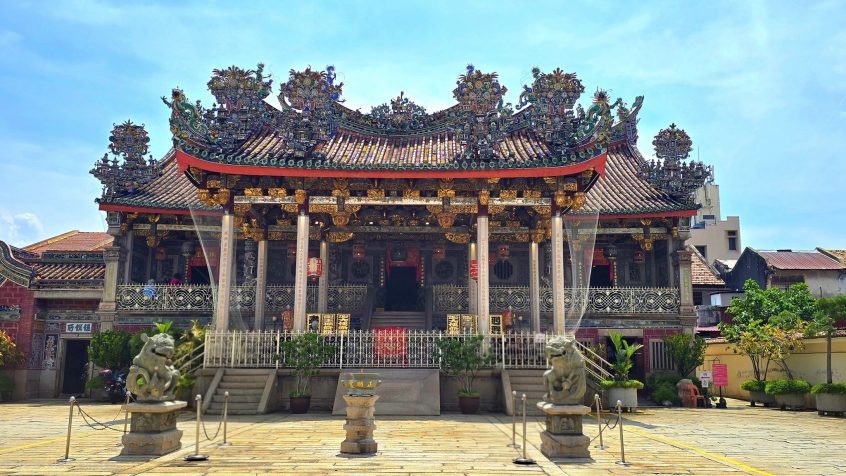
Back in the historic center, I headed first to the Khoo Kongsi, often referred to as the Khoo Clan House. Clan houses were central to Chinese immigrant life in Southeast Asia. When traders and laborers arrived in places like Penang in the nineteenth century, they brought little beyond their surnames and regional identities.
Clan associations (anyone sharing the same surname was automatically a member) became social safety nets, places of worship, meeting halls, arbitration courts, and mutual aid societies. They helped new arrivals find work, housing, and community. In a foreign land, the clan house was stability.
Today they remain powerful symbols of continuity. Some still function as active associations. Others, like Khoo Kongsi, operate as museums while continuing to anchor descendants to their ancestral roots.
Nothing prepared me for the visual assault of detail inside and out. Every inch was carved, painted, gilded, or inlaid. Intricate wood carvings depict mythical creatures and scenes from Chinese opera. Gold leaf glints in shadowy corners. Ceramic figurines march across beams. Panels are layered upon panels depicting symbolic imagery.
The roof alone was an architectural sculpture, ridges bristling with porcelain dragons, phoenixes, and warriors, frozen mid gesture. It is not decoration as accent. Decoration is the point.
From there I slowly wandered toward Armenian Street, home to George Town’s most famous street art. Penang’s murals are well known, often interactive, designed to engage passersby. I will admit, after the exuberance of Ipoh and the unexpected richness of Kuala Kangsar, these felt slightly less impressive. Perhaps I am becoming harder to wow.
That said, I did enjoy the pieces that incorporated real objects, a painted child reaching for an actual bicycle mounted against the wall, another perched on a real motorcycle. The combination of illusion and reality invited participation. People could not resist posing. They hopped onto the motorcycle, pretended to pedal the bicycle, leaned in as though part of the scene.
There’s also a curious fascination with cats. Murals of cats appear everywhere, in costumes, flying, dancing, or simply looking winsome.
Armenian Street is also lined with craft shops. I drifted in and out, grateful for air conditioning. Batik hung in bright folds, handmade jewelry glittered in glass cases, wooden carvings crowded shelves.
Yet I struggled to feel excited. Maybe I am jaded. I have spent decades wandering through markets across Asia, admiring intricate silk weaving in Thailand, refined ceramics in Japan, exquisite woodwork in Bali. Compared to those, much of what I saw here felt commercial, not compelling. Even the local batik, which I expected to admire, lacked the depth and finesse I have seen elsewhere.
I wondered whether this reaction said more about the crafts or about me. Travel has a way of raising expectations. The more I see, the higher my bar climbs. And in this heat, depleted and slightly woozy, I was less generous than usual.
By late afternoon I found myself once again seeking refuge in cool interiors, grateful for chilled air and a tall glass of anything icy. Outside, the sun continued its assault. Inside, I could reflect on the day’s contrasts, between haze and detail, devotion and commerce, expectation and reality.
Meanwhile, snow continued to fall in New York.
It struck me how absurdly adaptable we can be. Today I watched my phone overheat in tropical humidity. On Saturday I’ll be navigating icy sidewalks in boots and a down coat. My body will adjust, reluctantly, but it will.