
Today began in the cool air of the Cameron Highlands and ended in steamy Ipoh. Like the journey from Kuala Lumpur to the Highlands, the road was winding and at times steep. But where that earlier drive passed through largely undeveloped jungle that seemed ready to reclaim the pavement, today’s descent moved through highly cultivated farmland on noticeably more manicured roads, they even had curbs.
For kilometer after kilometer, we passed hillsides striped with rows of plastic-covered growing sheds. Long white tunnels stretched across the slopes like ribbons. These are vegetable farms; the coverings designed to protect crops from heavy rain and regulate temperature and moisture. Inside, lettuce, tomatoes, peppers, and other produce are grown year-round, much of it destined for urban markets. The effect is orderly and efficient, though slightly jarring against the surrounding rainforest.
As we descended, the vegetation shifted. The ferns and moss-covered branches that thrived in the cool mountain mist gradually disappeared, replaced by taller, broader-leaved trees and thicker tropical growth. The air grew warmer and heavier, something I could sense even through the car windows.
Before entering Ipoh, we passed mountains being mined for marble. From a distance they looked as though enormous bites had been taken out of them, sheer white faces exposed where dense vegetation once clung. As we drew closer, the scale became unmistakable. Entire hillsides had been cut into stepped terraces.
Then we approached Ipoh proper, a metropolitan area of roughly 900,000 people. It is distinctly urban, yet far less frenetic than Kuala Lumpur.
Ipoh’s history, like the marble quarries we had just passed, is written in stone. In the late nineteenth and early twentieth centuries, it was one of the world’s richest tin mining centers. Immense tin deposits transformed what had been a small settlement into a booming city almost overnight, not unlike the California Gold Rush. Chinese miners, British administrators, and traders flooded in. The grand colonial buildings that remain, including the railway station and civic structures, reflect that era of extraordinary wealth.
When global tin prices collapsed in the late twentieth century, Ipoh declined. Many young residents left for Kuala Lumpur or Singapore in search of opportunity. Yet in recent years, the city has experienced a renaissance. Its beautifully preserved Old Town, limestone cave temples, vibrant café culture, and growing reputation for street art, one of my favorite things to look for when I travel, have attracted visitors from around the globe. Ipoh is also famous for its “white coffee,” roasted with margarine and served sweet and creamy. I plan to try it tomorrow.
The first stop was at Tasik Cermin, also known as Mirror Lake, just outside Ipoh. Prior to boarding a boat to see the lake, I had to don a life jacket and a helmet. I thought that was an odd combination until we began. The lake is hidden behind towering limestone formations, completely concealed from the road. To get to the lake, the boat went through a low, dark tunnel and everyone on the boat had to duck down to avoid bashing our heads.
And then the space opens. On the other side lies a still, enclosed lake ringed by dramatic limestone cliffs that rise vertically from the water. The surface was calm and the cliffs reflected almost perfectly, giving Mirror Lake its name. It was once part of a limestone cave system whose roof collapsed gradually over time, allowing light to pour in and water to collect. The surrounding formations, stalactites and stalagmites, are hundreds of millions of years old.
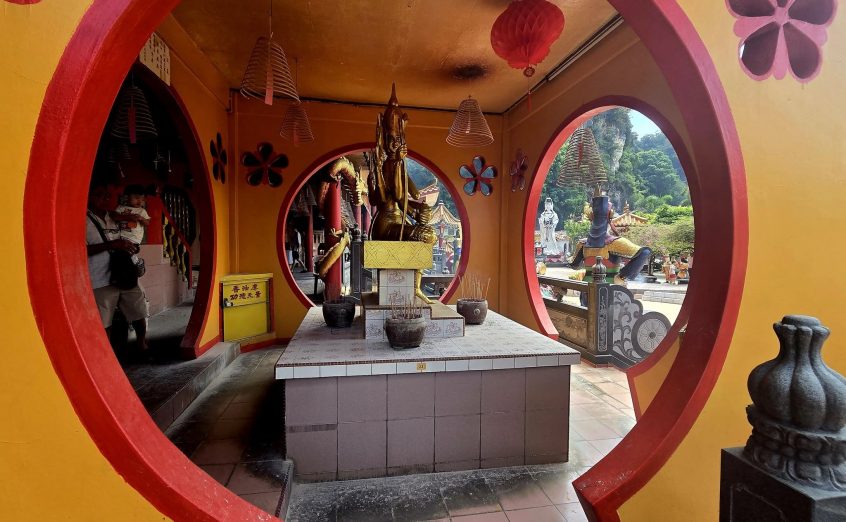
The next two stops were more modern but equally shaped by limestone. Ling Seng Tong Temple and Perak Tong Cave Temple are both Buddhist temples associated with caves. Ling Seng Tong is built against a rock formation, while Perak Tong, as its name suggests, is built inside a cave. But that is where the similarity ends.
Ling Seng Tong feels exuberant and theatrical. Built against a limestone outcrop, it spills outward rather than inward. The courtyard is crowded with brightly painted statues, deities, animals, mythological figures, each colorful and almost cheeky. The overall effect is lively and accessible, a place where devotion and visual fun coexist.
Perak Cave Temple, by contrast, feels contemplative. It is carved into a vast limestone cavern. The ceiling soars overhead, the stone cool and dimly lit. A towering, seated Buddha commands the entry space, serene and monumental. Murals line the walls, intricate and detailed, telling stories in soft pastels. Smaller, but still massive, gods and goddesses fill niches further in the cave. Throughout, the scent of incense is intense. Near the Buddha, an attendant struck a gong, the deep resonance echoing through the cavern and amplifying the solemnity of the space.
Each temple was impressive, and each entirely different from anything in the Judeo-Christian tradition. Yet both conveyed a clear sense of reverence, scale, and spiritual intention.
I ended the day in Ipoh city with a brief look at some of the British colonial buildings that remain from that earlier era of prosperity. Tomorrow I will return for a deeper exploration of the city’s streets, cafés, and history.