
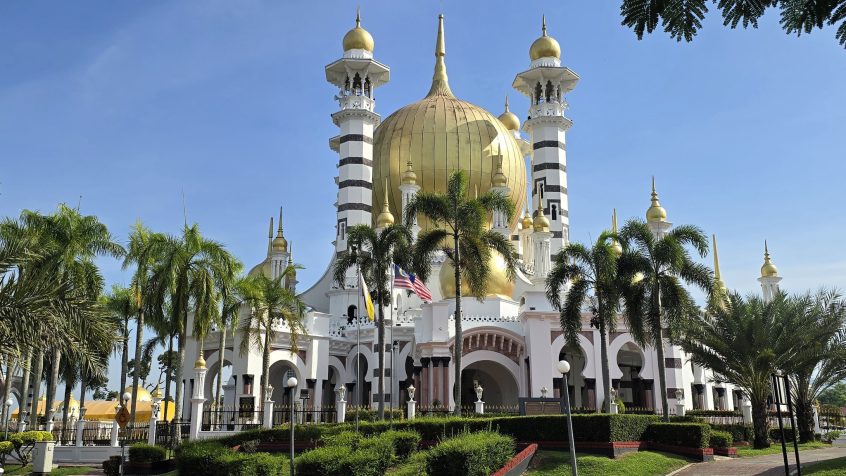
We left Ipoh early, hoping to beat the worst of the midday heat. For the first half-hour, we drove through wooded hills that could have been in New York State. That was replaced by palm plantations and rubber trees. We were heading to Kuala Kangsar, Malaysia’s royal town.
Kuala Kangsar is home to the Sultan of Perak, a constitutional monarch whose life straddles continents. He divides his time between this riverside town and London, counts King Charles among his friends, and is known to be an avid polo player. The grandest royal residence, Istana Iskandariah, sits behind gates and manicured grounds, including polo pitches. Not far away stands Istana Kenangan, the former palace built entirely of wood without a single nail. It is delicate looking, with tiered roofs and intricate latticework rising lightly above the trees. It’s now a museum focusing on the Sultan.
And yet, my most memorable moment in Kuala Kangsar was not royal at all. While my driver fiddled with Google maps looking for directions, I wandered a few steps down the street. I thought I’d seen a single mural. It turned out to be an entire street covered in murals. They depicted scenes of everyday life, women preparing food, children playing, villagers chatting, and, to my delight, artisans crafting baskets and ceramics.
Before marketing strategy, before fintech boardrooms and airports, before becoming a travel writer, I was a ceramicist. Seeing those paintings of potters convinced me to abandon our efficient route and set off in search of ceramic studios.
The search was less straightforward than imagined. We missed one turn, then another. GPS grew vague. Instead of workshops, we found ourselves meandering through tidy villages, neat wooden houses, potted plants arranged with care, laundry fluttering in the heat. It was the kind of accidental detour that no guidebook recommends and I treasure most, unfiltered glimpses into daily life. My driver thinks I am unconventional at best, but more likely slightly batty.
Eventually we located a couple of small ceramic shops. The work was not refined. Glazes were uneven, forms molded rather than hand thrown, decoration enthusiastic rather than precise. But the pieces are made to be used, not admired from behind glass. I found myself smiling, not critiquing.
From Kuala Kangsar we continued north toward Penang. The landscape flattened as we approached the coast, and crossing the bridge onto the island felt like a symbolic transition, from quiet royal town into something denser and livelier.
Penang is not large geographically, yet it carries outsized cultural influence. The state has roughly 1.8 million residents, with about half living on Penang Island itself. George Town, the capital, is compact enough to explore on foot yet so densely textured that every block holds another surprise, a temple wedged beside a café, a mural tucked into an alley, a century old shophouse painted in improbable pastel.
I found myself wondering whether Penang was primarily Chinese. It appeared that way. In fact, Penang has one of the highest proportions of ethnic Chinese residents in Malaysia, roughly 40 percent of the population. In George Town especially, the Chinese heritage is highly visible in the clan houses, temples, signage, and food culture. Yet the city is unmistakably multicultural with Malay, Chinese, Indian, and other communities layered together.
In 2008, George Town received recognition from UNESCO as a World Heritage Site, jointly listed with Melaka for its unique architectural and cultural townscape. The phrase sounds bureaucratic, but on the ground it is unmistakable. The city is one of the best-preserved historic trading ports in Southeast Asia. For centuries, merchants from China, India, the Malay world, the Middle East, and Europe passed through here. The result is a collage of architecture, Chinese clan houses, British colonial buildings, Indian temples, Malay mosques, and rows of narrow shophouses with interior courtyards designed for tropical airflow.
Strict conservation rules help explain why so much of this remains intact. Rather than bulldozed and replaced by glass towers, the shophouses endure, their peeling paint and shuttered windows preserved rather than neglected. But UNESCO recognition is not just about buildings. It honors living heritage, the festivals, the clan associations, the hawker stalls serving recipes handed down for generations.
My first stop was Chew Jetty, one of the remaining clan jetties built by Chinese immigrants in the nineteenth century. These waterfront settlements were organized by surname clans, extensions of kinship transplanted from southern China. Walking down the long wooden planks, houses perched on stilts above the water, feels like stepping into a living artifact.
The boards creaked underfoot. Doors stood open, revealing tiled floors, glowing red altars, family photos, drying laundry. Elderly residents sat in plastic chairs watching visitors drift past. Children zipped along on bicycles. The scent of salt air mingled with incense. Souvenir stalls have inevitably appeared, but daily life continues. It felt fragile, as though one powerful storm could sweep it away, and yet it has endured for generations.
My final stop of the day was Pinang Peranakan Mansion, and if Chew Jetty was intimate and weathered, the mansion was flamboyant and unapologetically grand.
The house once belonged to a wealthy Chinese Peranakan family. The Peranakans, often called Straits Chinese, are descendants of Chinese traders who settled in the Malay Archipelago and married local Malay women centuries ago. Over time they developed a distinctive hybrid culture blending Chinese tradition with Malay aesthetics, language, cuisine, and dress. By the nineteenth and early twentieth centuries, some Peranakan families in Penang had become extraordinarily prosperous, acting as intermediaries in global trade.
Walking through the mansion is like entering a gilded declaration of success. Carved wooden screens, imported European tiles, Scottish ironwork, Venetian mirrors, English chandeliers, Chinese porcelain, you name it, you can find it here somewhere. The building is enormous, with every inch decorated. There’s no minimalist restraint here. Wealth was meant to be seen.
And it is still the period of the Chinese New Year. The decorations made an already over-the-top décor even glitzier. Red lanterns clustered overhead. Gold accents flashed in the light. Fresh flowers and auspicious symbols appeared in every corner. The opulent interiors tipped into full theatrical celebration.
Throughout the rooms I noticed elegantly dressed visitors posing on the furniture (the rooms are meant to be used) and in front of carved screens. Women in embroidered silk kebayas, beaded slippers, ornate hairpieces, men in traditional jackets, all turning just so for the camera. I kept snapping pictures of them as they posed. I did ask permission and everyone was fine with my doing so. But I was puzzled why so many people were in period dress.
Only at the end did I discover the truth. Visitors could rent full Peranakan outfits and have their hair styled before wandering the mansion. Suddenly the posing made perfect sense. For a brief moment, anyone could inhabit this world of carved teak, porcelain, and layered identity. I loved that. History here is not roped off. It invites participation.
By the time I stepped back into the humid air, I realized how seamlessly the day had threaded together. In Kuala Kangsar, I stood outside royal palaces and chased echoes of my ceramicist past through village lanes. In George Town, I walked along wooden jetties built by immigrants, wandered streets protected for their layered heritage, and ended in a glittering mansion. It was a great day.