
Before leaving Marfa this morning, we stopped at the courthouse. Several people had told us the interior was a step back in time, and they were right. The original wood has been lovingly restored, and the architecture harkens back to an earlier West. Standing in the courtroom, I found myself thinking of Inherit the Wind with Spencer Tracy. I could easily imagine the Scopes trial unfolding here.
Our next destination was Alpine, but when we arrived we discovered that most of the places we wanted to explore are closed on Monday. So, we forged on to Marathon, thirty miles east. Along the way, we passed some of the longest trains I have ever seen, one so massive it required three engines to pull its weight.
My main reason for heading to Marathon was to pick up the painting I’d become enamored with in Marfa. The artist, George Zupp, had suggested that I come to his home / studio to get the painting.
I didn’t anticipate what happened next. George is a wonderful painter, but he’s also a folk artist / outsider artist who built his living space from found materials and decorated it in ways far from conventional. “Donald Judd was a minimalist,” he told me. “I am a maximalist.” It’s a prefect description. Every inch, both inside and out, is filled with art materials, collections of anything and everything that appeals to him, and unusual ways of creating art. One wall, covered entirely with crushed dog food cans, creates a strangely compelling, sculptural surface.
We spent a couple of hours with George, listening to his stories and trading thoughts about favorite outsider artists. It was one of those encounters that was both unexpected and entirely right.
He lives on the outskirts of town in an area that appears to be an artist colony. Funky is a great description of the houses and their décor.
Back in Marathon proper, we tried for lunch, only to find that the one café open on Mondays had just stopped serving. We settled for fruit smoothies instead, a less-than-ideal but fitting meal for a day that refused to follow a plan. Next door, a gallery of Western art and crafts offered some compensation, with several pieces that were striking and beautifully made.
All around the town are signs saying, “stop the wall.” Every shop handed out postcards asking “What’s happening on the Big Bend Border?” Everyone is incensed about the plan to build a 172-mile border wall on the Rio Grande corridor. The area is a historically low crossing sector. The wall would endanger ecosystems, diminish the protected dark sky area, destroy irreplaceable cultural sites. They suggest that everyone should visit the website NOBIGBENDWALL.ORG.
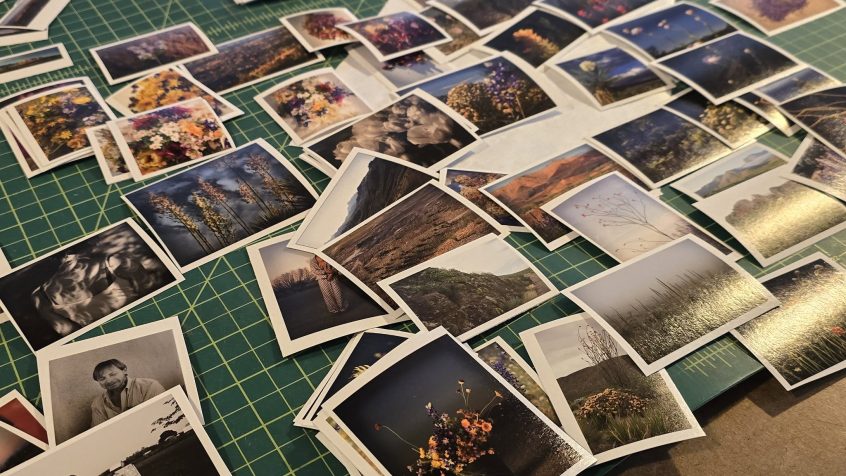
Our next stop in Marathon was to visit the gallery of James Evans, a friend of a friend of Liz. He’s a talented photographer, known for capturing the essence of West Texas. We spent time looking around his gallery and workshop, chatting, and perusing his photography books.
One final stop in Marathon, the Gage Hotel. Built in 1927, it is on the National Register of Historic Places. The public spaces are filled with hand-crafted wooden furniture from an earlier era. I would happily have stayed overnight there. But I’d made a reservation at much more modest accommodations in Alpine. So, we reversed our journey and headed back there.
Dinner turned out to be a fun experience. When we arrived at the Reata Restaurant, we were surprised to learn that we should have made a reservation. It turns out they are the only restaurant open on Mondays. We sat at the bar, which led to conversations with the people around us and the servers. It was a very social dinner.
In the end, this was a day of missed plans and unplanned moments, of closed doors and open conversations. West Texas rewards that kind of flexibility. You set out with an itinerary, but what stays with you are the detours, the people, and the places that do not fit neatly into any schedule.