
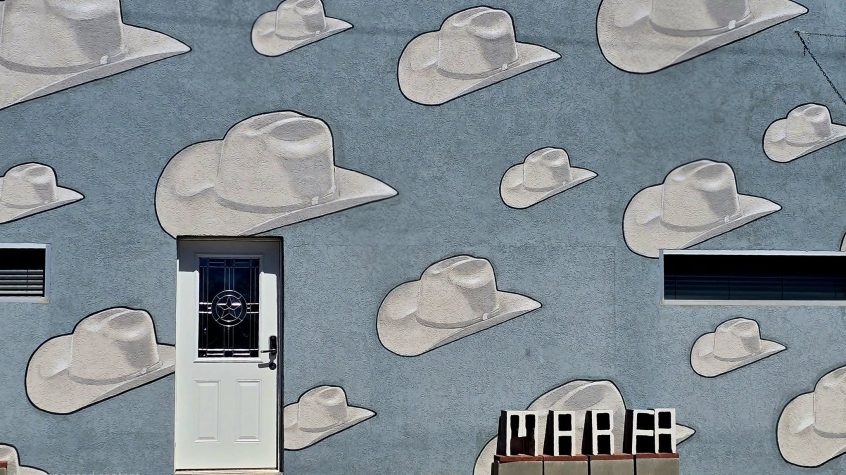
We began with breakfast at the Sentinel, part restaurant /coffee shop, bookstore, gallery, and informal town square. Within two minutes we were in conversation with a couple from Dallas. It is the kind of place that invites connection, whether you planned it or not.
Crossing the street, we wandered into a few shops. In one gallery I fell in love with a painting of a girl holding a ten-gallon hat. It will be coming home with me, eventually. The artist had finished it the night before and the paint was still wet. I will meet him in the town of Marathon in a couple of days to pick it up, which will somehow make the purchase even more memorable.
We drove on a meandering route around the town for a while appreciating the architecture. I also loved that there was no traffic. I made more U-turns this morning than I do in a year in New York.
Then it was off to the Chinati Foundation, the passion project of artist Donald Judd. Judd envisioned a place where art, architecture, and landscape would exist in permanent relationship to one another, rather than as temporary exhibitions.
The foundation sits on the former site of Fort D. A. Russell, a decommissioned U.S. Army post. The property spans roughly 340 acres and includes more than 100 buildings, from long concrete artillery sheds and former barracks to warehouses and hangars. Many of these structures have been repurposed to house large scale installations, their stark military origins now serving as an unexpectedly perfect backdrop for minimalist art. Others are housing for staff, artists, and apprentices.
To visit requires a reservation, fortunately I had arranged that before leaving New York. We opted for the “lite” tour, about an hour and a half, covering the main Judd installations and a couple of additional exhibitions. The full experience stretches to five hours.
Judd’s philosophy is deceptively simple. He rejected traditional painting and sculpture in favor of what he called “specific objects,” works that exist in real space, not as representations of something else. His goal was clarity, precision, and a direct relationship between the object, the space, and the viewer.
This is evident in his famous aluminum boxes, arranged in two former artillery sheds. Each building contains 50 identical aluminum cubes, placed in a straight line with perfect spacing. At first glance they appear uniform, but each one contains subtle internal variations.
Usually, I am not drawn to conceptual art, but I found these works mesmerizing. The floor to ceiling windows frame the desert outside, and as the light shifts, so do the reflections within the boxes. The landscape becomes part of the artwork. The longer I looked, the more differences I noticed, and the more engaged I became. The windows brought the outside in, and the inside moved out.
I was less enamored with some of the other artists, whose work leaned further into abstraction than I prefer. Still, I loved the property itself, the buildings, the vastness, even the tumbleweeds caught in the scrub brush, as though the land itself had decided to join the installation.
After the tour, we drove into the surrounding countryside. With no traffic to speak of, I stopped often to take photos, sometimes right in the middle of the road. The longer we stayed out there, the more I understood the appeal of this wide-open landscape. It is peaceful and a place to let all thoughts float away.
Back in town, we headed to the Hotel Paisano, known for its connection to the film Giant. We sank into comfortable chairs and waited for the bar to open at 2:30. We had a surprisingly good and remarkably inexpensive lunch in what felt like a movie set frozen in time.
Then, more wandering along back roads, because in Marfa that seems to be the point.
Tonight, we headed out in search of the Marfa Lights, mysterious glowing orbs that have puzzled visitors for generations. Whether they are science, illusion, or something else entirely, I have no idea. Liz swears she saw them, I’m sure I didn’t. The sunset, however, was magnificent.