
Tonight, as I write this, I am exhausted. It was a VERY full, and very wonderful, day. We started by driving to the outskirts of the city to the James Tellen Woodland Sculpture Garden. It is one of the artist-built environments that has been preserved by the Kohler Foundation.
We started by driving to the outskirts of the city to the James Tellen Woodland Sculpture Garden, one of the artist-built environments preserved by the Kohler Foundation. On a previous road trip through Wisconsin, I visited several other sites the foundation has maintained. There is something magical about these off-the-beaten-path places, created by ordinary people, usually untrained artists, who felt compelled to make something lasting.
Tellen’s environment is especially evocative, set deep in the woods, where trees and filtered light become part of the installation, framing his weathered concrete figures in a way that feels both intimate and slightly mysterious.
On our way back into the city, we stopped along Lake Michigan. It is so vast that standing at the shoreline feels like being at the edge of the ocean, minus the salt air and crashing waves, just a wide, quiet horizon stretching out in front of me.
Then it was off to the main reason I wanted to come to Sheboygan, The Art Preserve of the John Michael Kohler Arts Center. It opened to the public in 2021, as a facility devoted to artist-built environments, the first museum of its kind.
Inside, more than 25,000 objects are held in the collection, with thousands on view at any given time. What makes it different from other outsider art museums (such as the American Visionary Art Museum in Baltimore) is its focus on immersive environments. There are entire worlds created by largely self-taught artists, often reconstructed from the artists’ homes and yards. Many of these artists worked obsessively, producing thousands, sometimes tens of thousands, of objects over a lifetime. Here, instead of seeing a single example, you see them in depth, enough to begin to understand the rhythm, repetition, and sheer force of the original environments.
Even the building reinforces this idea. With its visible storage and open shelving, it feels less like a traditional museum and more like walking through a living archive, one where nothing is entirely hidden away.
After the first two floors, we were on such overload we needed to take a break before we could tackle the final floor. Because I am unlikely to return here any time soon, I wasn’t going to miss a single thing. We had tea, charged our phones (I had already taken hundreds of photos), chatted with the staff and relaxed before heading for the remaining exhibits. Exhausted as I was, it was worth it, the third floor contained some of my favorite pieces.
I’d been told by a couple of people that while at the Preserve and at the Museum I had to look at the bathrooms. They are artist designed and whimsical.
The lovely staff at the Preserve suggested that the John Michael Kohler Arts Center had a café with excellent food. They were correct. We ate lunch and relaxed before tackling this separate museum. I was glad we’d gone to the Preserve first; I was disappointed with the displays at this exhibition site. Frankly, that was a good thing, not sure I could have survived another multi-level, jam-packed display of mesmerizing art.
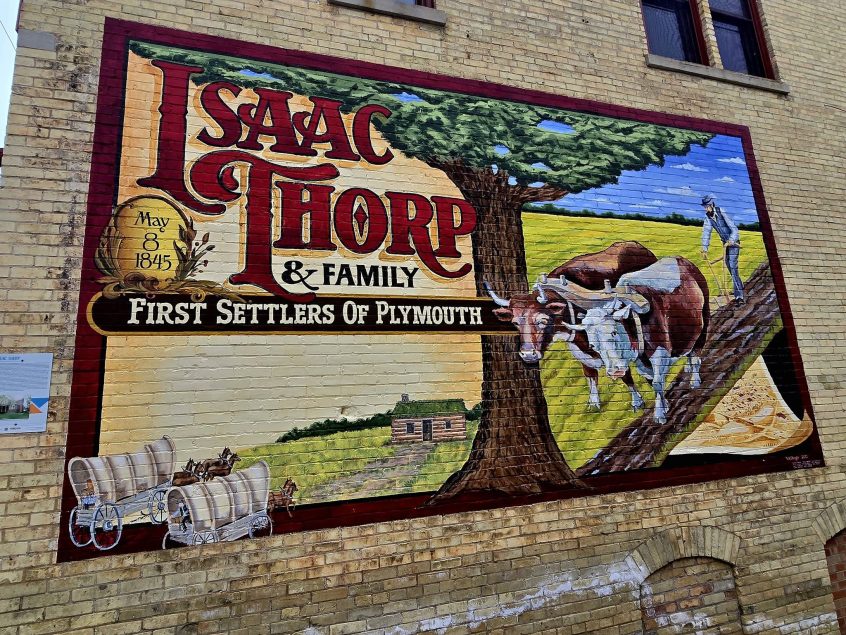
It was now mid-afternoon. We weren’t ready to go back to the hotel, so we headed to the town of Plymouth, the self-proclaimed Cheese Capital of the World. Cheese wasn’t our motivation for going there, murals were. It was easy to drive around, hop out of the car for a minute and take photos. We were both too tired to walk on the mural trail.
What stays with me tonight is not any single piece, but the quiet persistence behind all of it, the way these artists kept building, adding, shaping their worlds piece by piece, often without recognition, simply because they had to.
I leave Sheboygan deeply moved, and more than a little humbled by what people create when no one is watching.