
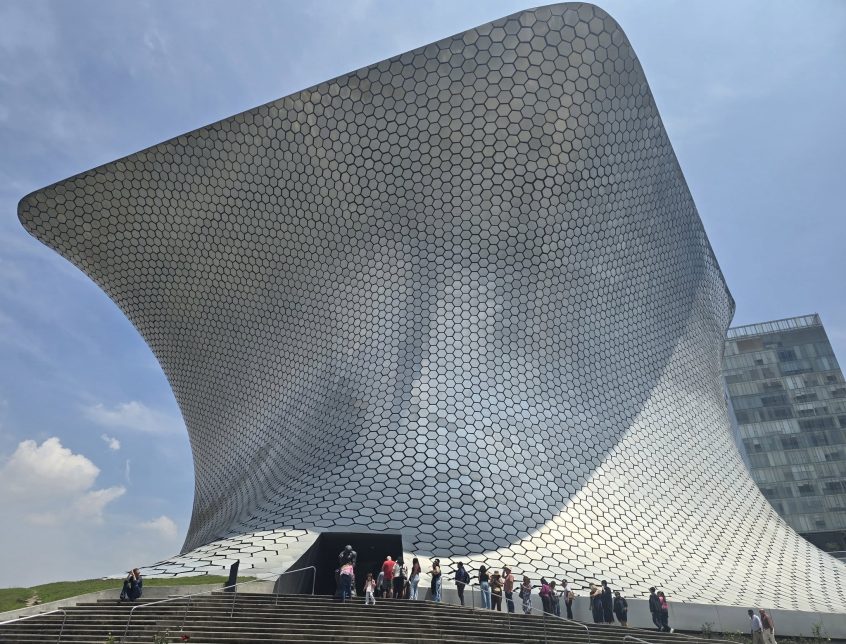
The Museo Soumaya’s architecture alone makes it worth a visit, even if art museums aren’t your thing. The windowless, metallic six-story building looks a bit like a surrealist hourglass covered in thousands of gleaming silver tiles. It’s impossible to ignore. It’s the centerpiece of Nuevo Polanco, a very modern, very wealthy section of Mexico City that’s still growing.
The museum houses the collection of Carlos Slim, the wealthiest man in Mexico. And when you’re one of the richest men in the world, it seems your art-shopping budget is limitless. It is quite a collection.
As I wandered through the museum, the sheer diversity surprised me. Mexican art, European masters, Chinese ivory carvings, religious art, manuscripts, sculpture, and an entire top floor devoted largely to Rodin, including a cast of The Thinker. In fact, the museum has the largest collection of Rodin outside France, with over 300 of his works.
The juxtapositions can be startling. A full-size replica of Michelangelo’s David dominates the lobby, accompanied by Rodin’s The Gates of Hell, as well as a reproduction of Michelangelo’s Pietà. Upstairs, a Salvador Dalí sculpture is near the work of a relatively unknown painter, with de Chirico and drawings by Khalil Gibran nearby. It sometimes felt less like a conventional museum and more like wandering through the mind of an extraordinarily enthusiastic collector.
One of my favorite discoveries was the Mexican art. Apart from a few famous names, like Diego Rivera and Frida Kahlo, I’m largely unfamiliar with Mexican artists of the last century. Considering how much time I spend looking at art, it was humbling, and exciting, to discover so many accomplished artists whose work was completely new to me.
By the time I met my friend Sophia for lunch, I needed a break. The museum crawl is tough on my back and knees.
As always, she chose an outstanding restaurant, Anatol. The décor is simple, the food anything but.
Lunch lasted for hours as we caught up. Last September Sophia walked the Camino de Santiago, and I wanted to hear all about it. Eventually, we reached dessert: a cherry pie that may be the GOAT of cherry pies. Decadent beyond belief, it had a flaky crust surrounding enormous, whole, dark-red cherries that tasted as though they had just been picked. I’m not sure I can ever look at an ordinary cherry pie the same way again.
After lunch, Sophia drove me to a part of Chapultepec Park I’d never visited and introduced me to the Lerma water system, a massive engineering project designed to bring water into Mexico City. The Cárcamo de Dolores was built in 1951 to commemorate the water system’s completion. But creating a major piece of municipal water infrastructure wasn’t enough. They invited Diego Rivera to add art.
Inside the Cárcamo, Rivera created Water, Origin of Life on Earth, a mural celebrating the role of water in the evolution of life. Outside is something even harder to miss: another Rivera piece, an enormous mosaic sculpture depicting Tláloc, the Aztec god of rain and water.
Art, engineering, ancient mythology, and municipal plumbing. Somehow, in Mexico City, they all belong together.
Sophia then drove me through Las Lomas, one of the few parts of Mexico City that wasn’t built on the old lakebed. It is one of the city’s wealthiest residential neighborhoods, home to embassies, enormous houses, and old money discreetly hidden behind walls and gates.
I didn’t eat dinner. After that cherry pie, there wasn’t room for so much as a tortilla chip.